Chewing gum for the brain: Why do people talk such rubbish about Media Studies?
Why Media Studies is worth studying.
This gave me very good points for my personal statement, and explore ways in which media actually is a worthwhile degree. The lecturer spoke passionately about how Media is rapidly becoming a huge part of societies life. Lecturer, Professor Buckingham, explained how media studies is being represented in broadsheet newspapers. That in one guardian article, media studies was said to be a 'soft' subject
Online media, Cleggmania, and the Cowell Factor.
How do online media and convergence impact on the ways audiences and producers use and create media?
This was also very interesting, the mixture of the competition and the fact that they spoke about the X factor, which has become a part of everyone’s lives. Also the idea that harrow on the hill is such an expensive school, and that people tend to put down those who do not take on “Academic” subjects. Lecturer, Dr. Julian McDougall, explained the links between reality TV, the web, and politics. One really good point was that this year, the 3 parties in competition all appeared on reality TV on channel 3 in order to target a wider audience.
Perfecting your production work.
How to get the most out of your practical projects.
I wasn’t here for this part.
Tuesday, 2 November 2010

Do alternative representations exist of male and/ or female roles in the hip hop genre?
I didn’t want to do something expected or typical so I decided to do: Your Love by Nicki Minaj.
Immediately we are given an alternative representation of women in this hip hop video,
stereotypically we associate the make gender with rapping, however here we have a woman rapping, which breaks away from this stereotype.

However the way she is dressed (geisha outfit), portrays her as a piece of decoration, objectifies her, which is how women are pretty much represented as in hip hop videos. Her stiff position, excessive accessories and heavy makeup, almost dehumanises her, and portrays her as an object of desire. Though she is covered from the top, long shots which enable the viewers to gaze upon her legs, fetishises her and sexually objectifies her.

There is also a direct mode of address, which would usually be from the male and the women would be in the back admiring the man, but would not have enough superiority to look at the camera. By giving a direct mode of address, Minaj represents herself to be in control, which gives her the power which stereotypically the males have.

Women are stereotypically supposed to be just looked at and do not take on the male jobs, such as fighting or hard labour work. In the video, all the women are learning karate, which is supposed to be too aggressive for the female gender, this shows that women are represented as equal to men, however this can be argued against by the fact that their teacher is a male. This can suggest that men will always be superior to women, and have to teach the women the vital techniques of survival.

Shots where the women look at the man, represent that they are inferior to the men, as if they are damsels in distress, and the high angle shots, show us how the man sees Minaj, and she looks up to him, as if he is her saviour.

The colour, red that all the women wear, can connote power, however this power is diminished as the man wears Black, which is more of a masculine colour and blocks out the chance of any other colour conquering his ( which can also connote that a woman can never surpass the male gender).

The two women then fight for the man, which sometimes is and isn’t presented in hip hop videos, however society increasingly associates the men to be the fighters, and even in fairy tales we usually see the good guy and the bad guy fighting for the girl. This again challenges the male dominancy, and gives women physical strength. We could also say that the swords can represent the phallus and that as the women have them in their hands, they are now in control but another interpretation can suggest that this connotes that women must have some sort of male ability to survive.

The final shot I think strongly shows an alternative representation of women. As Minaj lies dying, the male sits beside her and looks to the camera in distress/anger/pain and sorrow, again which is stereotypically the role a woman would play. For years we see in not only music videos such as Hero by Enrique Iglesias but also movies that the man dies for the one he loves, and the woman runs whilst sobbing to him and hold him as he dies, so here we see the male takes on this role and is portrayed quite feminine. Also as he looks up, red rose petals fall upon him, which is a feminine flower, this can suggest that his feminine side is coming out as he cries whilst he watches his love die. Another interesting change I found by the end is that, the fact that the man survives can suggest that the female gender is too weak to survive and also by the end Minaj is fully dressed in Black, whereas the man now wears both red and Black, which can suggest as downfall in power for the man. The colour red can connote femininity, as it is a colour associated with love, lust and sexiness, which are all key words stereotypically associated with the female gender. Therefore it is key to notice that he wears both these colours, whereas in the beginning he just wears black, giving him all the power, but now Minaj holds all the power.
Immediately we are given an alternative representation of women in this hip hop video,
stereotypically we associate the make gender with rapping, however here we have a woman rapping, which breaks away from this stereotype.

However the way she is dressed (geisha outfit), portrays her as a piece of decoration, objectifies her, which is how women are pretty much represented as in hip hop videos. Her stiff position, excessive accessories and heavy makeup, almost dehumanises her, and portrays her as an object of desire. Though she is covered from the top, long shots which enable the viewers to gaze upon her legs, fetishises her and sexually objectifies her.
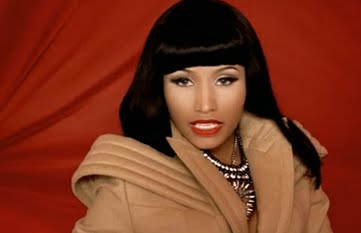
There is also a direct mode of address, which would usually be from the male and the women would be in the back admiring the man, but would not have enough superiority to look at the camera. By giving a direct mode of address, Minaj represents herself to be in control, which gives her the power which stereotypically the males have.

Women are stereotypically supposed to be just looked at and do not take on the male jobs, such as fighting or hard labour work. In the video, all the women are learning karate, which is supposed to be too aggressive for the female gender, this shows that women are represented as equal to men, however this can be argued against by the fact that their teacher is a male. This can suggest that men will always be superior to women, and have to teach the women the vital techniques of survival.

Shots where the women look at the man, represent that they are inferior to the men, as if they are damsels in distress, and the high angle shots, show us how the man sees Minaj, and she looks up to him, as if he is her saviour.

The colour, red that all the women wear, can connote power, however this power is diminished as the man wears Black, which is more of a masculine colour and blocks out the chance of any other colour conquering his ( which can also connote that a woman can never surpass the male gender).

The two women then fight for the man, which sometimes is and isn’t presented in hip hop videos, however society increasingly associates the men to be the fighters, and even in fairy tales we usually see the good guy and the bad guy fighting for the girl. This again challenges the male dominancy, and gives women physical strength. We could also say that the swords can represent the phallus and that as the women have them in their hands, they are now in control but another interpretation can suggest that this connotes that women must have some sort of male ability to survive.

The final shot I think strongly shows an alternative representation of women. As Minaj lies dying, the male sits beside her and looks to the camera in distress/anger/pain and sorrow, again which is stereotypically the role a woman would play. For years we see in not only music videos such as Hero by Enrique Iglesias but also movies that the man dies for the one he loves, and the woman runs whilst sobbing to him and hold him as he dies, so here we see the male takes on this role and is portrayed quite feminine. Also as he looks up, red rose petals fall upon him, which is a feminine flower, this can suggest that his feminine side is coming out as he cries whilst he watches his love die. Another interesting change I found by the end is that, the fact that the man survives can suggest that the female gender is too weak to survive and also by the end Minaj is fully dressed in Black, whereas the man now wears both red and Black, which can suggest as downfall in power for the man. The colour red can connote femininity, as it is a colour associated with love, lust and sexiness, which are all key words stereotypically associated with the female gender. Therefore it is key to notice that he wears both these colours, whereas in the beginning he just wears black, giving him all the power, but now Minaj holds all the power.
Tuesday, 19 October 2010
BIANCA'S: What are the different representations of women in adverts and how are they signified?
The representation of women can be positive: challenging the roles and expectations of women or negative: reinforcing a patriarchal society. This essay questions how and why these representations are constructed in an advert for Gucci Guilty Perfume and Stella Artois beer.
Firstly the Gucci advert is in widescreen which connotes a dramatic cinematic experience to engage its audience. More attention is gained by the female character first seen in the text and her protagonist is signified through this. The protagonist has female dominance which is signified through the use of colour- everything is in black and white while her hair is gold/blonde. This colour connotes gold, power and divinity signifying her importance in the text.
The use of intertextuality in this text will appeal to a particular audience. The film references a great deal to the neo film noir Sin City, with the use of colour and the female dominant femme fatale character. Sin City appeals to a male audience due to the action genre, this trailer could also appeal to the same audience due to the intertextuality. In terms of the Uses and Gratifications theory, a female audience might realise and accept the protagonist in the text is a form of escapism and also a male gaze, by theorist Mulvey, and therefore might aspire, from Young and Rubicam's 4Cs, to be the object of male gaze too.
Though the protagonist is an object of male gaze, it could be suggested that she sexually objectifies herself to tease the audience. The protagonist puts her leg into the frame of the shot. As she puts into the frame, it signifies self objectification, allowing the audience to fetishise her body. Another shot, a high angle, of their sexual activities signifies CCTV and spying which is voyeuristic. The fact she is on top signifies her control of the situation for both the male character and the audience.
Not only does the protagonist exert her feminity through self objectification she also presents herself as an anarchic character signified by adopting male stereotypes. The advert begins with a long shot of an unknown character speeding down the motorway, which stereotypically would be expected to be a male character. However, the audience's expectations are challenged when a medium shot of the driver shows to be a female.
In contrast, women are negatively represented in the Stella Artois text. The most obvious editing technique used in the advert is the split screen: one side shows the female getting dressed and the other side is of the beer getting "prepared". This use of split screen signifies that neither the beer nor the woman know they have been placed side by side. This puts the audience in position of control as they can voyeur the woman, in a socially acceptable way. Audiences may identify this control as patriarchy, and also identify with the unknown male character whose presence is felt within the text. This text then reinforces the idea of a patriarchal society and that women are subordinated by men.
Not only does the female share the screen with the beer, but the screen is split equally between the two "objects" which connotes the woman is equally objectified to the status of beer. It is suggested the audience is male due to the female and beer subject. Though the advert is targeted at men, it also negatively stereotypes men as people who have little respect for women which however is a dominant representation.
A range of close up shots of the female are used to fetishise her body. There is a close up shot of the female's leg slowly and elegantly rising from the bath tub. On one hand this could signify femininity and her control over it which is the oppositional reading. However, the more dominant reading is that her legs are an important part of the female body and connotes a male audience who can voyeur her body.
The text near the beginning of the trailer says "the preparation" which is an enigma code as the audience question "what event is the preparation for?". It is signified through the shots that the woman and beer preparation is for the male through the use of action codes. Action codes of both the preparation of the woman and the glass of beer are the same.
Women are represented as people who prioritise their looks and appearance, and this ad reinforces this ideology. Action codes including close ups of her: brushing her hair, doing her make up and putting on heels strongly represent women as image conscious. It could be said that the advert reinforces this representation, which is always seen in the media. Funnily enough, it could also be said that the media itself is the cause of this representation as this ideal, perfect woman is always represented in the media, and women feel they have to aspire to it.
In conclusion, both texts females are the protagonists and are sexually objectified for male audiences to fetishise and vouyer their bodies. However, while Gucci’s advert’s protagonist controls her sexuality through self objectification, the Stella Artois’ protagonist is objectified by an unknown but present male character.
In the Gucci’s ad, there are many examples in the text that signify the protagonist’s female dominance, but it is arguable whether this could be seen as a positive representation. The dominant reading is that the protagonist exerts her female dominance over the male challenging the historical patriarchal society and even subordinating males as easily manipulated and easily tempted by women and sex and this would favour feminism. However the oppositional reading which would favour the ideologies of the Stella Artois advert, might be that females can control their sexuality, but it is still for the male gaze and male dominant society.
Firstly the Gucci advert is in widescreen which connotes a dramatic cinematic experience to engage its audience. More attention is gained by the female character first seen in the text and her protagonist is signified through this. The protagonist has female dominance which is signified through the use of colour- everything is in black and white while her hair is gold/blonde. This colour connotes gold, power and divinity signifying her importance in the text.
The use of intertextuality in this text will appeal to a particular audience. The film references a great deal to the neo film noir Sin City, with the use of colour and the female dominant femme fatale character. Sin City appeals to a male audience due to the action genre, this trailer could also appeal to the same audience due to the intertextuality. In terms of the Uses and Gratifications theory, a female audience might realise and accept the protagonist in the text is a form of escapism and also a male gaze, by theorist Mulvey, and therefore might aspire, from Young and Rubicam's 4Cs, to be the object of male gaze too.
Though the protagonist is an object of male gaze, it could be suggested that she sexually objectifies herself to tease the audience. The protagonist puts her leg into the frame of the shot. As she puts into the frame, it signifies self objectification, allowing the audience to fetishise her body. Another shot, a high angle, of their sexual activities signifies CCTV and spying which is voyeuristic. The fact she is on top signifies her control of the situation for both the male character and the audience.
Not only does the protagonist exert her feminity through self objectification she also presents herself as an anarchic character signified by adopting male stereotypes. The advert begins with a long shot of an unknown character speeding down the motorway, which stereotypically would be expected to be a male character. However, the audience's expectations are challenged when a medium shot of the driver shows to be a female.
In contrast, women are negatively represented in the Stella Artois text. The most obvious editing technique used in the advert is the split screen: one side shows the female getting dressed and the other side is of the beer getting "prepared". This use of split screen signifies that neither the beer nor the woman know they have been placed side by side. This puts the audience in position of control as they can voyeur the woman, in a socially acceptable way. Audiences may identify this control as patriarchy, and also identify with the unknown male character whose presence is felt within the text. This text then reinforces the idea of a patriarchal society and that women are subordinated by men.
Not only does the female share the screen with the beer, but the screen is split equally between the two "objects" which connotes the woman is equally objectified to the status of beer. It is suggested the audience is male due to the female and beer subject. Though the advert is targeted at men, it also negatively stereotypes men as people who have little respect for women which however is a dominant representation.
A range of close up shots of the female are used to fetishise her body. There is a close up shot of the female's leg slowly and elegantly rising from the bath tub. On one hand this could signify femininity and her control over it which is the oppositional reading. However, the more dominant reading is that her legs are an important part of the female body and connotes a male audience who can voyeur her body.
The text near the beginning of the trailer says "the preparation" which is an enigma code as the audience question "what event is the preparation for?". It is signified through the shots that the woman and beer preparation is for the male through the use of action codes. Action codes of both the preparation of the woman and the glass of beer are the same.
Women are represented as people who prioritise their looks and appearance, and this ad reinforces this ideology. Action codes including close ups of her: brushing her hair, doing her make up and putting on heels strongly represent women as image conscious. It could be said that the advert reinforces this representation, which is always seen in the media. Funnily enough, it could also be said that the media itself is the cause of this representation as this ideal, perfect woman is always represented in the media, and women feel they have to aspire to it.
In conclusion, both texts females are the protagonists and are sexually objectified for male audiences to fetishise and vouyer their bodies. However, while Gucci’s advert’s protagonist controls her sexuality through self objectification, the Stella Artois’ protagonist is objectified by an unknown but present male character.
In the Gucci’s ad, there are many examples in the text that signify the protagonist’s female dominance, but it is arguable whether this could be seen as a positive representation. The dominant reading is that the protagonist exerts her female dominance over the male challenging the historical patriarchal society and even subordinating males as easily manipulated and easily tempted by women and sex and this would favour feminism. However the oppositional reading which would favour the ideologies of the Stella Artois advert, might be that females can control their sexuality, but it is still for the male gaze and male dominant society.
Monday, 18 October 2010
Representation of Men and Women in adverts.
It's hard to find any advert that represents women in a positive way, especially just after the war. Then though this was the feminist era, women were still very much inferior and even in adverts they were presented in their stereotype roles.
http://www.youtube.com/watch?v=tQ0FRW1W3yA&feature=related
This advert for Coca Cola though still representing women in negative way, to some extent does portray women to have atleast some power. We see Anita Byrant running towards the camera, in a swimsuit, as she runs she has four men running after her saying "Hey wait for me". Stereotypically we would see the female gender running after the male gender, however this is not the case in the advert. We then see all the men surround her and they are topless, and even though Byrant is also in swimwear, this makes the two sexes somewhat equal.
Furthermore, there is a sense of a patriarchal society, when Byrant holds the 'king size' coke, as it is a phallic symbol, and the dialogue 'king size coke has more for you' suggests that men can do more/ men have more power.
http://www.youtube.com/watch?v=ho9XNfy6JBM
The first shot, shows a woman with beads in her mouth, shes fetishized as she says 'nothing takes it off like...' , and she stokes the product which again is a phallic symbol, she is very much sexualised. She then repeats, 'take it off', which is very sexual, therefore she is represented as a sex object. Also in the end, the male triumphs and get's the girl, therefore representing a patriarchal society. However the idea that the male is perfect and does not need to do anything about the way he looks, is challenged, as he's the one who is perfecting his looks to get the woman.
http://www.youtube.com/watch?v=wbiofcuTZBo&feature=related
This advert I found very interesting, because it represents women in a much positive way, and at the same time presents men in a superior and inferior way. Mr clean, in the advert cleans the whole house, which is stereotypically a womans job in that period of time, and the product itself is called Mr. Clean, which is odd beacuse we would associate the female sex with the cleaning jobs. At second 20-22, the character stands in a very womanly way, with his assets out, and he cleans the baby, again a feminine job. By the time the woman arrives the whole house is clean by the man, which suggests that men can do anything, therefore they are the superior sex.
http://www.youtube.com/watch?v=OM59nSkjEWU&feature=related
Again, it was really hard to find anything from the 1950's-1970's period of time, but I think this advert pretty much represents the male gender as the more superior gender. Even though he is looking after his appearance, which we would usually see the woman doing, however in the end he get's the woman he want's, and she is literally throwing herself on him, which shows how easy it is to pull the girl. He looks really happy, and he does not so much of the talking, so again we get the sense of a patriarchal society.
http://www.youtube.com/watch?v=dz1a3LHSvnY
Though a contemporary advert, the setting is around 1940's-1950's, and yet we get the sense that nothing has changed. The little Boy gets the bread ( which can literally means he's the breadwinner because he's a male), and he battles his way through all these obstacles, showing that he is physically strong, and ends with the little boy in more modern clothing at the table with the bread. Again it reinforces the idea that not much has changed and the male gender will always be superior.
http://www.youtube.com/watch?v=5QKRZaktc2Y
This advert, though it does not overtly represent men as sex objects, it reverses the gender roles. We see the man, in a very metrosexual way, he is hairless which is an expectation people have of women, and the woman comes to give the guy a towel, which is somewhat like her protecting him. Men are supposed to be masculine, but with his hair stripped off of him, his masculinity fades too.
http://www.youtube.com/watch?v=Hbib-A6NpW8b
This is just found very interesting, as we see shots of the men pole dancing, therefore becoming feminine, and then shots where the airhostess puts the man to sleep, which puts her in a stereotypical rold of a mother.
http://www.youtube.com/watch?v=tQ0FRW1W3yA&feature=related
This advert for Coca Cola though still representing women in negative way, to some extent does portray women to have atleast some power. We see Anita Byrant running towards the camera, in a swimsuit, as she runs she has four men running after her saying "Hey wait for me". Stereotypically we would see the female gender running after the male gender, however this is not the case in the advert. We then see all the men surround her and they are topless, and even though Byrant is also in swimwear, this makes the two sexes somewhat equal.
Furthermore, there is a sense of a patriarchal society, when Byrant holds the 'king size' coke, as it is a phallic symbol, and the dialogue 'king size coke has more for you' suggests that men can do more/ men have more power.
http://www.youtube.com/watch?v=ho9XNfy6JBM
The first shot, shows a woman with beads in her mouth, shes fetishized as she says 'nothing takes it off like...' , and she stokes the product which again is a phallic symbol, she is very much sexualised. She then repeats, 'take it off', which is very sexual, therefore she is represented as a sex object. Also in the end, the male triumphs and get's the girl, therefore representing a patriarchal society. However the idea that the male is perfect and does not need to do anything about the way he looks, is challenged, as he's the one who is perfecting his looks to get the woman.
http://www.youtube.com/watch?v=wbiofcuTZBo&feature=related
This advert I found very interesting, because it represents women in a much positive way, and at the same time presents men in a superior and inferior way. Mr clean, in the advert cleans the whole house, which is stereotypically a womans job in that period of time, and the product itself is called Mr. Clean, which is odd beacuse we would associate the female sex with the cleaning jobs. At second 20-22, the character stands in a very womanly way, with his assets out, and he cleans the baby, again a feminine job. By the time the woman arrives the whole house is clean by the man, which suggests that men can do anything, therefore they are the superior sex.
http://www.youtube.com/watch?v=OM59nSkjEWU&feature=related
Again, it was really hard to find anything from the 1950's-1970's period of time, but I think this advert pretty much represents the male gender as the more superior gender. Even though he is looking after his appearance, which we would usually see the woman doing, however in the end he get's the woman he want's, and she is literally throwing herself on him, which shows how easy it is to pull the girl. He looks really happy, and he does not so much of the talking, so again we get the sense of a patriarchal society.
http://www.youtube.com/watch?v=dz1a3LHSvnY
Though a contemporary advert, the setting is around 1940's-1950's, and yet we get the sense that nothing has changed. The little Boy gets the bread ( which can literally means he's the breadwinner because he's a male), and he battles his way through all these obstacles, showing that he is physically strong, and ends with the little boy in more modern clothing at the table with the bread. Again it reinforces the idea that not much has changed and the male gender will always be superior.
http://www.youtube.com/watch?v=5QKRZaktc2Y
This advert, though it does not overtly represent men as sex objects, it reverses the gender roles. We see the man, in a very metrosexual way, he is hairless which is an expectation people have of women, and the woman comes to give the guy a towel, which is somewhat like her protecting him. Men are supposed to be masculine, but with his hair stripped off of him, his masculinity fades too.
http://www.youtube.com/watch?v=Hbib-A6NpW8b
This is just found very interesting, as we see shots of the men pole dancing, therefore becoming feminine, and then shots where the airhostess puts the man to sleep, which puts her in a stereotypical rold of a mother.
Saturday, 16 October 2010
Gender In Advertising
1. What sort of images of women and men dominated advertising pre-1970s? Why was this the case?
After 1950’s the ‘housewife’ image started to decline, however this stereotypical image was still very common throughout the 60’s and 70’s. The reason for the decline is mostly to do with the fact that due to the Second World War, women were gaining more rights. Women had to become the breadwinners whilst their husbands were sent abroad to fight, however when the men came back, women were sent back to their original jobs. The feminist ear soared because women were fighting for more rights, but didn’t get that far, so in adverts their stereotypical image maintained.
2. How did the advertising of the 1970’s continue to perpetuate the stereotype of women, despite depicting women in a greater range of roles?
Schiebe (1979) In a Study of TV Ads found out that women were more concerned about beauty, pleasing men with their looks and family, so even if women were shown to be in different environments, they were still shown in their stereotypical images. This meant that even though the feminist movement had some sort of affect on advertising, women were still represented in their stereotypical roles.
3. Can Gaye Tuchman’s quote regarding under-representation and the ‘symbolic annihilation of women’ still be applied in 21st Century advertising? If so, how?
Symbolic annihilation is basically when media texts under represent a group of people, or represent the group in a different way, which results in viewers undermining the group. I think that this can be still applied to the 21st century. Even until now, women are not equal, we do not associate the sexes to the same occupations, and if we see in an advert, that a woman is in power, we still see her as a sex symbol, a femme fatale, though she has power we still undermine her and treat her like a subordinate, because we’ve been treated with the hypodermic needle theory and have become passive viewers of the media, and accept everything we are shown.
4. Do you agree that adverts, such as those for the 1990’s Boots No. 7, ‘It’s not make-up. Its ammunition.’ campaign, are post-feminist (thereby representing women as better than men?). Explain your answer.
I completely disagree, I think rather than represented women as better than men, and they are saying that women are using their looks and charm to be better than men, rather than being better than them as a sex. Its also related to the quote ‘if looks could kill’ so it’s not really a positive thing, they are saying if you want to be like a femme fatale (who always falls in the end) then wear makeup.
5. Is the representation of women by the media accountable for the results of a survey in which ‘women were up to ten times more likely than men to be unhappy with their body image’?
I think that the media is somewhat accountable for this result, but also the society is to blame and their expectations. There is an unending cycle about who to blame for this, did society influence what we see in the media, or did the media affect the society’s expectations, and we can never come to a true explanation. But I think the media overtly represent women to be ‘perfect’ and the real women are presented as outsiders, so women are unhappy with how they look because they can’t be perfect.
6. Is the contemporary representation of men in advertising perhaps also a negative one where they too are treated as sex objects?
Men are also being objectified, but not as heavily as women are, and have been for so long. Men are still portrayed as just right, and women need to enhance their looks to attract this dominant sex.
After 1950’s the ‘housewife’ image started to decline, however this stereotypical image was still very common throughout the 60’s and 70’s. The reason for the decline is mostly to do with the fact that due to the Second World War, women were gaining more rights. Women had to become the breadwinners whilst their husbands were sent abroad to fight, however when the men came back, women were sent back to their original jobs. The feminist ear soared because women were fighting for more rights, but didn’t get that far, so in adverts their stereotypical image maintained.
2. How did the advertising of the 1970’s continue to perpetuate the stereotype of women, despite depicting women in a greater range of roles?
Schiebe (1979) In a Study of TV Ads found out that women were more concerned about beauty, pleasing men with their looks and family, so even if women were shown to be in different environments, they were still shown in their stereotypical images. This meant that even though the feminist movement had some sort of affect on advertising, women were still represented in their stereotypical roles.
3. Can Gaye Tuchman’s quote regarding under-representation and the ‘symbolic annihilation of women’ still be applied in 21st Century advertising? If so, how?
Symbolic annihilation is basically when media texts under represent a group of people, or represent the group in a different way, which results in viewers undermining the group. I think that this can be still applied to the 21st century. Even until now, women are not equal, we do not associate the sexes to the same occupations, and if we see in an advert, that a woman is in power, we still see her as a sex symbol, a femme fatale, though she has power we still undermine her and treat her like a subordinate, because we’ve been treated with the hypodermic needle theory and have become passive viewers of the media, and accept everything we are shown.
4. Do you agree that adverts, such as those for the 1990’s Boots No. 7, ‘It’s not make-up. Its ammunition.’ campaign, are post-feminist (thereby representing women as better than men?). Explain your answer.
I completely disagree, I think rather than represented women as better than men, and they are saying that women are using their looks and charm to be better than men, rather than being better than them as a sex. Its also related to the quote ‘if looks could kill’ so it’s not really a positive thing, they are saying if you want to be like a femme fatale (who always falls in the end) then wear makeup.
5. Is the representation of women by the media accountable for the results of a survey in which ‘women were up to ten times more likely than men to be unhappy with their body image’?
I think that the media is somewhat accountable for this result, but also the society is to blame and their expectations. There is an unending cycle about who to blame for this, did society influence what we see in the media, or did the media affect the society’s expectations, and we can never come to a true explanation. But I think the media overtly represent women to be ‘perfect’ and the real women are presented as outsiders, so women are unhappy with how they look because they can’t be perfect.
6. Is the contemporary representation of men in advertising perhaps also a negative one where they too are treated as sex objects?
Men are also being objectified, but not as heavily as women are, and have been for so long. Men are still portrayed as just right, and women need to enhance their looks to attract this dominant sex.
Wednesday, 13 October 2010
Negative Representation of Women

To start off, the fact that the women are puppets in the advert, just starts off presenting them in a negative way. As we associate puppets as objects therefore objectifying the female gender, and also these objects are controlled by humans which in this case are the males, therefore categorising the men in the dominant group and the women in the subordinates. As the main subject sees more work on her desk, she slams her fists in rage, suggesting that women cannot not do paper work, and are weak, again presenting women in a negative light. Then we go on to see that her eyes ‘lighten’ up when she sees DIET coke. The fact that it is diet coke, can infer that women should be image conscious and in fact are image conscious, also even though she needs a break, she still needs to maintain her look, creates a male dominating atmosphere around the advert.
Then all the girl puppets line up and dance towards the drink machine, inferring that all the women are the same and they should all just drink Diet coke, which in some sense is quite misogynistic, because the women are objectified, then categorised as one, and on top of that they are shown “the right way”. When the subject pushes her button, she uses her heel which I think is suggesting that women have to use accessories, or charms to gain power, and physically there is nothing powerful about them. The slogan saying “if you love it light” is put next to a can of diet coke, held up by string. Throughout the advert the puppets are also held up from strings, this is trying to promote a negative message that women should ‘light’ in weight and therefore need to be image conscious and drink something that will make them ‘light’ in hopes that someday a man may love them. In this sense we are opened up to a patriarchy society, and the message of the advert is that women are controlled by men and they must do all that the men expect from them, including looking just right.
Another very interesting thing about this advert was the soundtrack they used, “Maniac” by Michael Sembello. The key lyric from this soundtrack which is played upon the advert is “She’s a maniac, maniac on the floor, and she’s dancing like she’s never danced before”. With these lyrics in mind, and watching the advert, we can infer that the women are represented as mad (subordinate) women, who are crazy about losing weight, as the puppets dancing like they’ve never danced before to get the diet coke (this can also betaken as a misogynitic element).
http://www.youtube.com/watch?v=e1mkS0X6gJ8 (Link to the advert)
Sunday, 10 October 2010
Positive representation of Women

The advert begins with the subject in a complete black outfit, which would stereotypically be a skirt and a short top, however here this stereotype is challenged, and we see the female in clothes we associate with the dominant sex (male). Her hair is tied black in a sleek pony tail, and she wears no jewellery, which again does not conform to the stereotype of women wearing earrings or necklaces to promote their femininity. We see in the background, images of eyes, which connotes all the attention on her, however rather than gaining the attention through the male gaze (Mulvey), by objectifying her, we see that she gains this attention as she challenges the male dominancy. As she scratches the floor with her heel, everyone turns to see her, and she is clearly in control, as all eyes are on her. Though she gains the attention through her powerful actions, we can still say that she somewhat conforms to the stereotypical female attitude, as she uses her heel to gain attention which is a very feminine iconography. Also she wears a very bright Pink lipstick and she squints her eyes to give a cat like affect, therefore connoting that women are sly, and very sexual, as we commonly now see how cats in specific are extremely sexualised in adverts.
She reaches for the perfume bottle which in this case if represented as a phallic symbol, as she lets out an orgasmic sound as she pulls it out from her pocket. This specific shot can both portray her in a positive and negative way. In one way we can infer that she is shown as an independent woman, who can please herself without having a male figure there (this can also represent her as the femme fatale), or it can show, that regardless of how powerful the woman is, she always needs a phallic symbol to please herself. When she starts spraying the perfume everywhere, the soundtrack kicks in, and we see shots of lights turning on, this can suggest power, and show that now that she has the perfume is in control, and therefore does not need a man. She starts to jump about, and in the end we see her in a very masculine stance, as she spells out “Elle” with her perfume, which means girl in French. This can suggest that though she is a female she can always have the control she wants as long as she has the perfume, which then represents her in a negative light as we can understand that a woman can get nowhere without her charm.
We are given a very feministic view on women in this advert. The subjects costume is very masculine, and we get a shot where she jumps and you have a high angle shot, and is looks as if she’s not even wearing a bra, which all lot of women decided not to wear after World War 2 as they wanted to be as equal as men.
http://www.youtube.com/watch?v=xTWmUItM01c (Link to the advert)
Subscribe to:
Posts (Atom)